Recycled wool and synthetics
Verify feedstock, blend, yarn route, traceability and performance. Recycled content does not by itself establish lower total impact.

Evaluate recycled fibers, lower-impact dye routes, functional finishes and composite structures with explicit baselines, test scope and installation constraints.
Verify feedstock, blend, yarn route, traceability and performance. Recycled content does not by itself establish lower total impact.
State bio-based fraction, source, processing, durability and end-of-life boundary rather than treating the label as universal evidence.
Consider backing, adhesives, dyes, finishes, trims and realistic recovery route before making recyclability claims.

Define the baseline and compare water, energy, auxiliaries, yield, shade range, colorfastness and minimum batch on equivalent cloth. A process is not “low impact” without a measured boundary and comparable function.
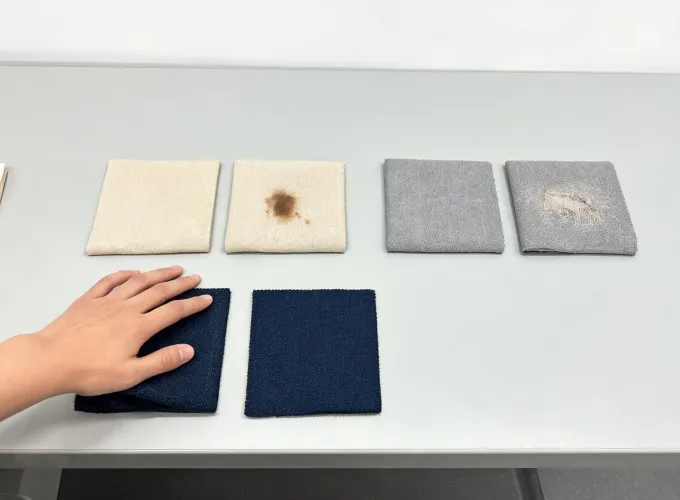
Target stain release, repellency, flame or easy-care behavior, then review chemistry, add-on, curing, durability, handfeel, color, air permeability and maintenance. A finish result remains scoped to the tested construction.

Evaluate layer identity, bond route, flexibility, delamination, mounting, cleaning and separation. Added function may increase material complexity and constrain repair or recycling.
No customer result, lifecycle reduction, certificate, facility or capacity is inferred where brand facts are unavailable.
Scale review includes fiber and yarn availability, dye-lot minimum, yield, shade range, usable width, repeat, backing, finish application and production stability. A laboratory sample can establish a direction without proving that bulk cloth will retain the same hand, color, durability or installation behavior.
Environmental comparisons require equivalent function and a stated system boundary. Durability, cleaning, repair, replacement and end-of-life route can alter the conclusion. Where data is absent, the proposed benefit remains a hypothesis rather than a quantified reduction.
Share baseline, changed variable, intended benefit, test and installation constraints.